Chenyue Li

Master's Student in Electrical Engineering
Stanford University

Chenyue Li

Hi! I am a master's student in Electrical Engineering at Stanford University, where I work with Prof. Serena Yeung-Levy at the MARVL Lab and Prof. Ehsan Adeli at the STAI Lab.

Previously, I was a research intern at Microsoft Research Asia (MSRA), working with Dr. Fangzhao Wu on LLM reasoning and reinforcement learning. I received my bachelor's degree in Computer Science and Technology from Wuhan University.

My research interests lie in AI agents and their real-world applications, with a particular interest in AI for Biomedicine. I am interested in developing AI agents that can understand complex scientific information, reason over experimental evidence, and contribute to biological research and scientific discovery.

Publications

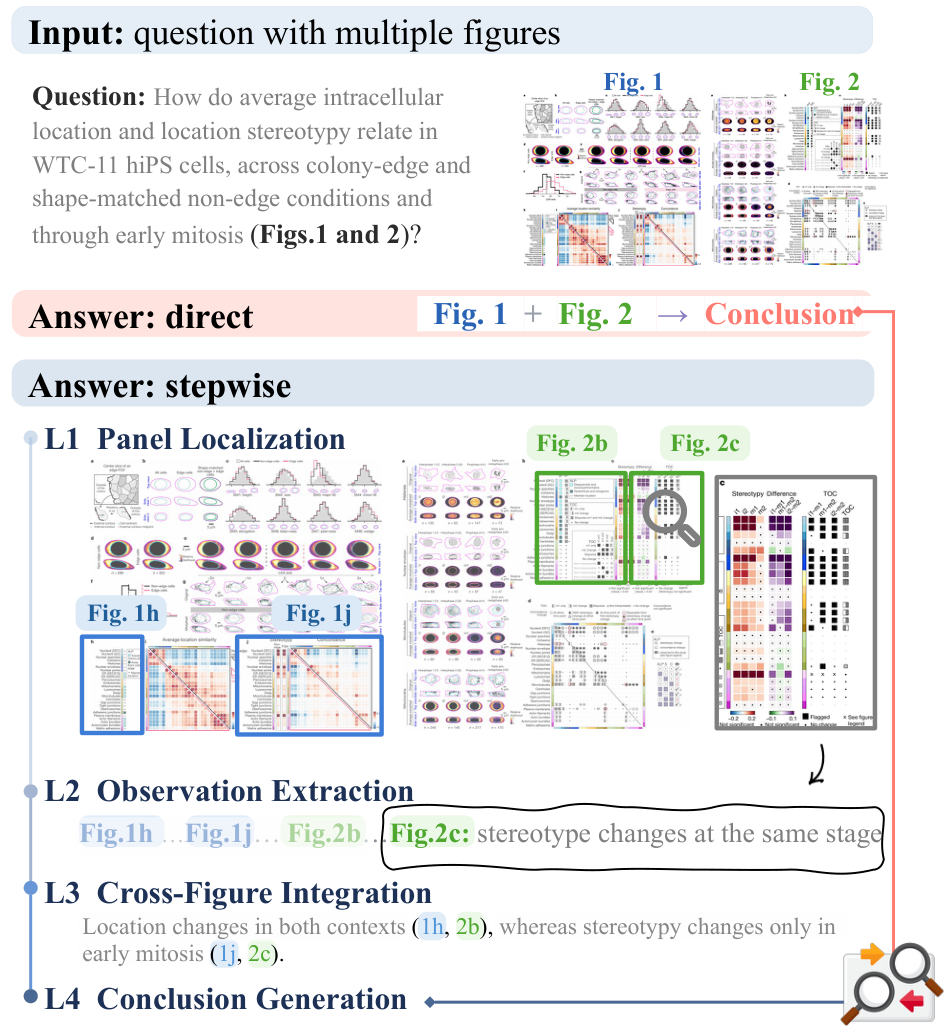
BioThread Figure 1: the Direct and Stepwise tasks, from panel localization and observation extraction to cross-figure integration and conclusion generation. View figure
Biomedical scientific reasoning

BioThread: Tracing Claim–Evidence Reasoning in Biomedical Scientific Figures

Chenyue Li, Xiaoxiao Sun, Huangqingbo Sun, Yuwei Yang, Elaine Sui, Qinlin Zhao, Emma Lundberg, Serena Yeung-Levy

We introduce BioThread to evaluate whether vision-language models can interpret biomedical experimental figures, integrate evidence across experiments, and draw scientifically supported conclusions. We further develop an evidence-grounded agent to improve scientific reasoning, with the broader goal of enabling AI agents to support biological research.
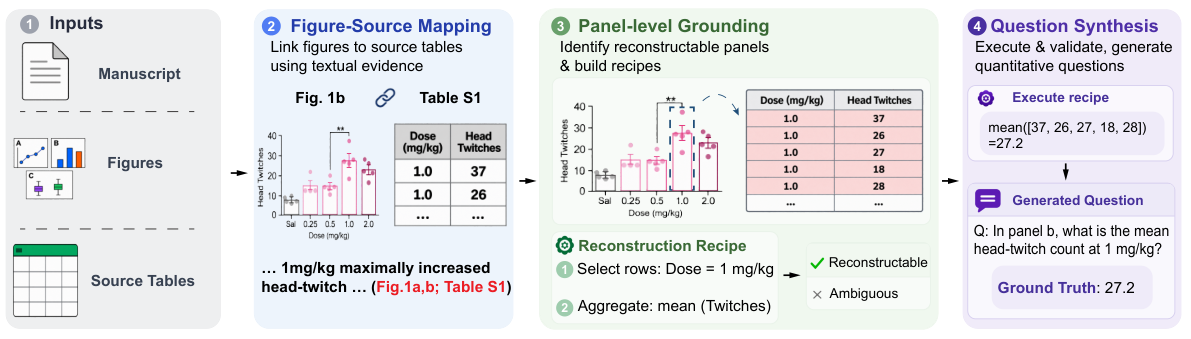
PlotGround pipeline for mapping scientific figures to source tables, grounding their panels, and synthesizing quantitative questions. View figure
Scientific figure understanding

arXiv, 2026

PlotGround: Grounding Plot Digitization in Real Scientific Figures and Their Source Data

Yaohui Zhang, Binxu Li, Haoyi Duan, Jiacheng Miao, Yixin Wang, Xinran Du, Chenyue Li, Shilong Liu, Kevin Wu, James Zou

We introduce a benchmark construction pipeline that links real scientific figures to their source data, enabling verifiable evaluation of plot digitization. The resulting benchmark tests how accurately multimodal models recover numerical values from published figures.

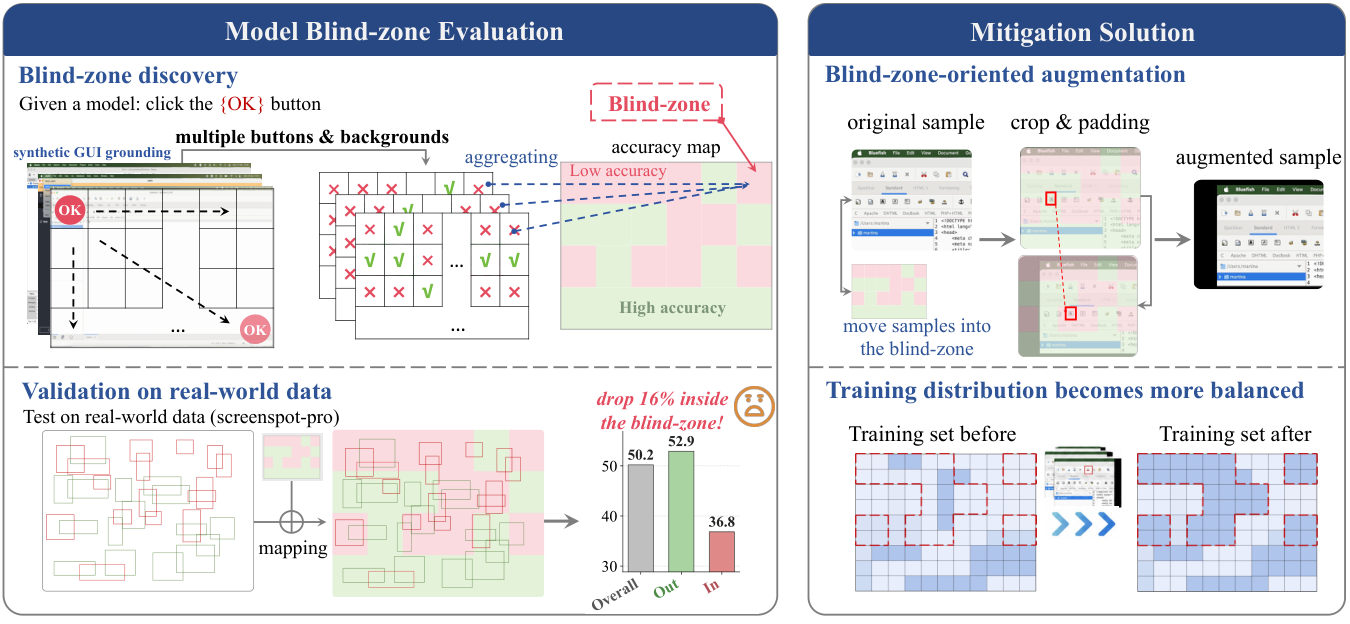
ScreenHaystack Figure 2: spatial blind-zone evaluation and targeted data augmentation. View figure
GUI grounding

EMNLP 2026, Main Conference

ScreenHaystack: Finding Blind Zones in GUI Grounding

Chenyue Li, Xiaoxiao Sun, Yubo Deng, Qinlin Zhao, Serena Yeung-Levy, Yuhui Zhang

We introduce a dynamic benchmark to investigate the spatial reliability of GUI grounding models. We identify systematic spatial blind zones in existing models and propose a targeted data augmentation strategy to improve grounding performance.

Overview of Transformer-based person, vehicle, and animal re-identification. View figure
Visual representation learning

International Journal of Computer Vision (IJCV), 2025

Transformer for Object Re-Identification: A Survey

Mang Ye, Shuoyi Chen, Chenyue Li, Wei-Shi Zheng, David Crandall, Bo Du

We provide a comprehensive review of Transformer-based object re-identification across different modalities and learning settings, establish new experimental benchmarks, and discuss open challenges in the foundation model era.

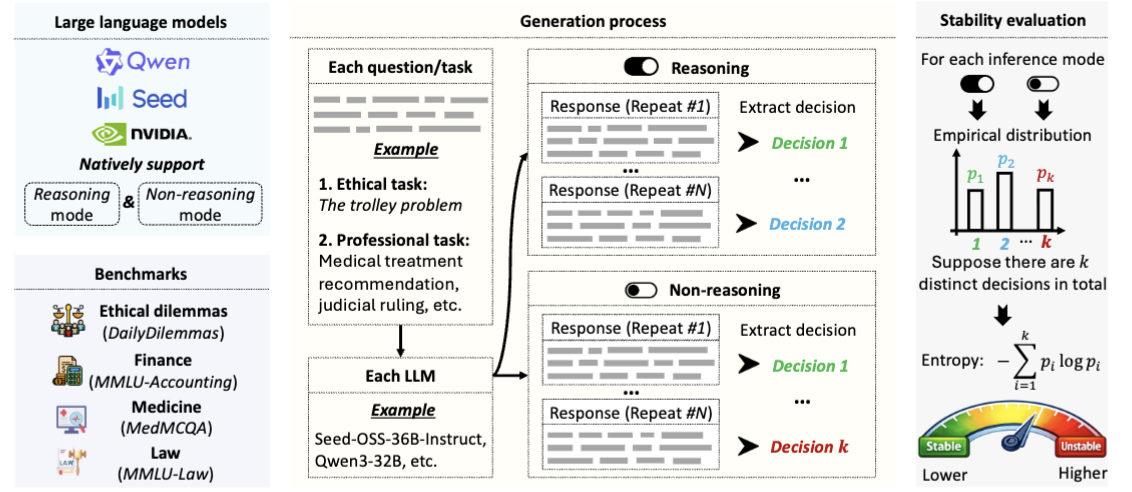
Experimental workflow from the reasoning and decision stability study. View figure
Reliable decision-making

Reasoning Improves LLMs’ Stability in Decision Making

Dacheng Wen, Chenyue Li, Chenglong Wang, Xiaoyuan Yi, Jing Yao, Mingxiao An, Bin Zhu, Wei Chen, Lingjuan Lyu, Junming Huang, Xing Xie, Bu Zhong, Francis C. M. Lau, Yupeng Li, Fangzhao Wu

We investigate the role of reasoning in improving the stability of LLM decision-making across ethical and professional domains. Our findings demonstrate that reasoning can improve decision consistency independently of accuracy gains.

In Preparation

SHAPE: Scale- and History-Aware Patient Emulation

Stanford University, STAI Lab

In collaboration with Prof. Ehsan Adeli.

We develop a patient simulation agent that integrates psychological assessments and longitudinal conversation history to emulate realistic, personalized patient behavior in psychotherapy. This project explores the potential of AI agents for mental health research and clinical training.

Education

Stanford University

– (Expected)

Wuhan University

–

Research Experience

Stanford University — MARVL Lab

November 2025 – Present

Research Intern

Advisor: Prof. Serena Yeung-Levy

Stanford University — STAI Lab

September 2026 – Present

Research Intern

Advisor: Prof. Ehsan Adeli

Microsoft Research Asia — Social Computing Group

March 2025 – September 2025

Research Intern

Mentor: Dr. Fangzhao Wu

Honors & Awards

  • Microsoft “Star of Tomorrow” Award (MSRA)2025
  • National Scholarship (Award rate: 0.2% nationwide)2024
  • Chinese Collegiate Computing Competition — National First Prize (Team Leader)2024
  • First-Class Scholarship2023, 2024
  • Longfor Scholarship (Award rate: 0.1% university-wide)2023

Research figure